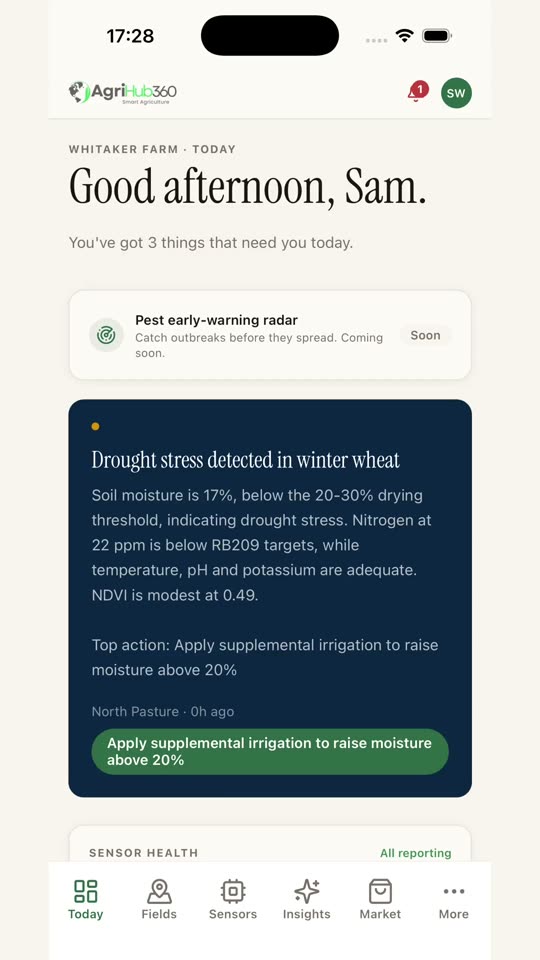
 Play · 0:40
From reading to alert to action.
Soil temperature and moisture say the window is open. The app turns it into one sentence with a deadline, and one button that tells the crew.

Like the lab soil test you send off once a year, except you can read this one every day.
You buy seed once a year and guess which variety suits the field.
Varieties ranked on your own microclimate, once the field has a season behind it.
A nutrient deficit found at harvest is found too late to save the crop.
Live soil readings and plain-language alerts while there is still time to act.
Irrigation runs on the calendar and the forecast rather than on the soil.
Water the fields that need it, and leave the ones that do not.
Fertilising the whole field at one rate wastes both input and yield.
Doses tuned to each field, against an RB209 plan you can show anyone.
Fertiliser goes on to a plan written before the season started.
A rate and a date drawn from what the soil actually holds this week.
SFI, NVZ and the Farming Rules for Water all want parcel-level evidence on demand.
The record is written as the work happens, and exports when asked.
One does the paperwork. One reads the field. We do both.
Soil Benchmark, Omnia, fieldmargin, TELUS
RB209, NVZ and SFI done properly, from national data. No way to bring a reading in from a field.
CropX, xFarm, Sencrop
Sensors and stations, some of them anyone’s. No British statutory paperwork.
Both jobs, one record
RB209, NVZ, Nmax and SFI on modelled values for free, and on measured ones from our node or a device you connect yourself.
Real screens, real readings, under a minute each.
Play · 0:40
Soil temperature and moisture say the window is open. The app turns it into one sentence with a deadline, and one button that tells the crew.
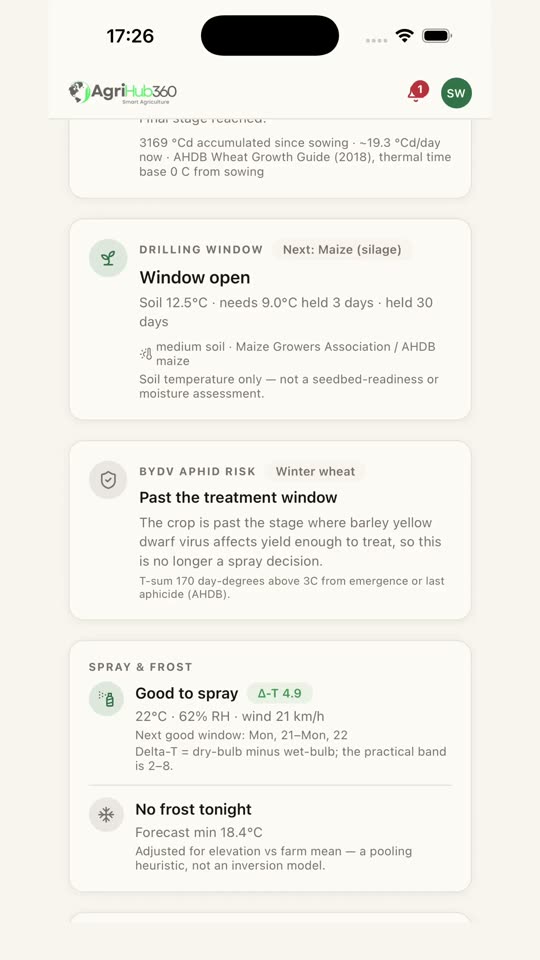 Play · 0:43
Soil temperature opens the drilling window. Delta-T and frost risk set the spray window. You see the span and pick the day.
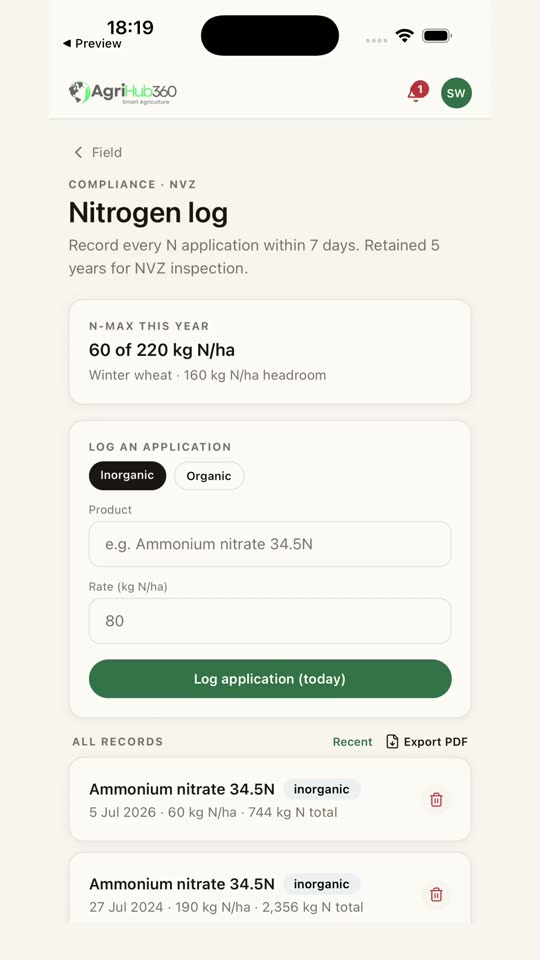 Play · 0:33
Every fertiliser application logged within seven days, kept for the five years NVZ asks for, exported as a PDF the RPA recognises.
EUDR, SFI and NVZ all want parcel-level evidence. The app keeps the record as you work and exports it in the shape each scheme asks for.
If you sell into the EU, every commodity needs parcel-level provenance. Large operators are caught from 30 December 2026; micro and small operators get a simplified track to 30 June 2027. Our sensor and harvest records cover the field side: geolocation, dates, what was grown where.
Five years of nutrient records, kept on file. Every fertiliser and spray application is logged as the work happens. Export them when DEFRA or the Environment Agency asks.
AgriHub360 is not a registry, a verifier or a certification body. It is the field-level record those bodies sit on top of.